Since its inauguration in November 2014, the container terminal at the port of Lomé has quickly attracted a large volume of goods from transit to landlocked countries.
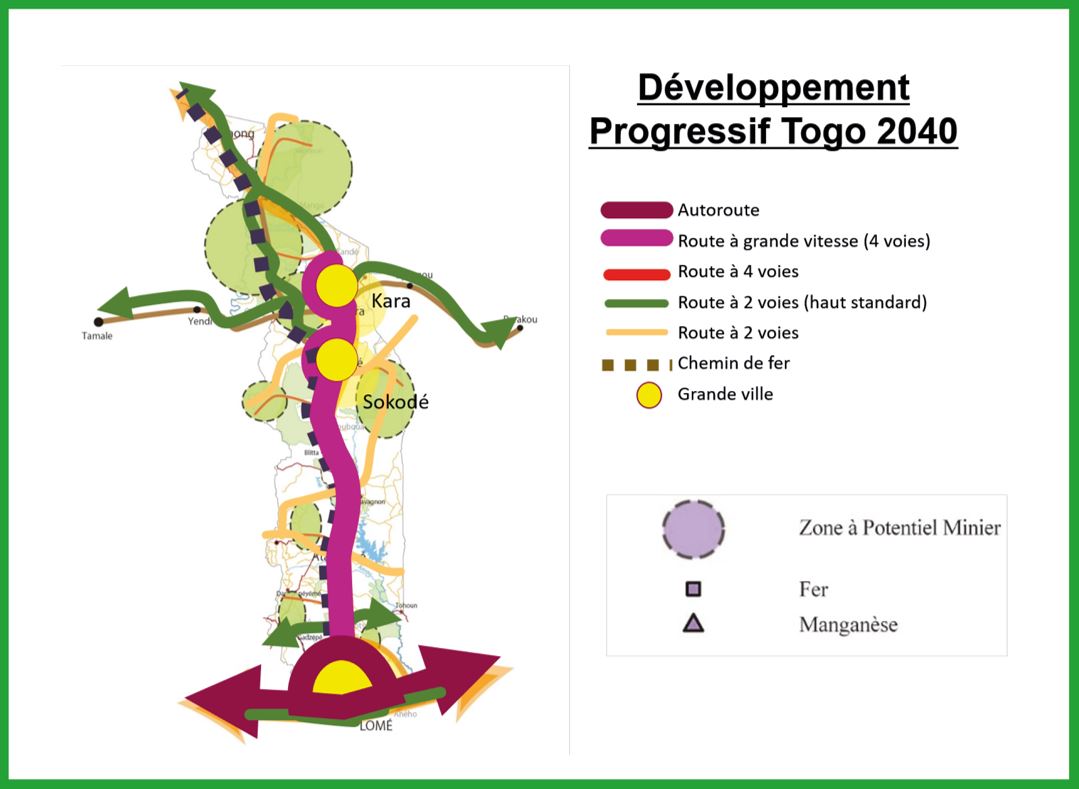
Togo continues to develop the north-south roads of the Lomé-Ouagadougou corridor and road-based logistics industries, alongside the development of the port of Lomé.
However, the countries of the Gulf of Guinea (Côte d’Ivoire, Ghana, etc.) are significantly developing their ports (Abidjan and Tema) to compete with the Lomé container terminal. If the volume of goods handled continues to increase, the port of Lome, the main asset of the Lome-Ouagadougou corridor, risks losing its competitiveness (its functions and its attractiveness) because of the congestion in the surrounding area. A solution to this problem is essential.
Despite the agricultural potential of its interior, Togo’s industrial development is unsatisfactory, although it does have two well-developed infrastructures: the port of Lome and the north-south road (two lanes; a ring road already exists in the northern mountains) of the Lome-Ouagadougou corridor. It should be noted that the agricultural potential is not being exploited.
In addition, Greater Lome is the closest of the other agglomerations on the Abidjan-Lagos corridor to Lagos and has a competitive port. As a result, Togo will be able to go beyond a development focused on services such as logistics, and realise a system of distribution of manufacturing sectors along the Abidjan-Lagos corridor. As a result, the Lome Convention will have greater potential for manufacturing.